Tidy Tuesday: useR! 2025 Conference Program

tidytuesday
R
conference
text-analysis
tidytext
Mining the useR! 2025 program to map the intellectual landscape of the R community: which topics dominate, how the week is structured, and what the conference schedule reveals about where R is headed.
Author

Sean Thimons

Published

April 29, 2025

Preface

From the TidyTuesday repository.

The user2025.csv dataset contains the complete program for the useR! 2025 conference, held at Duke University (Durham, NC) from August 8–10, 2025, with a virtual conference option on August 1, 2025. The dataset includes information about all keynotes, technical talks, tutorials, and poster presentations. useR! conferences represent “the premier global venue for the R community since 2004,” bringing together developers and users worldwide.

Suggested questions: Identify emerging themes and topics across conference sessions; build interactive conference program applications; create visualizations promoting participation in useR! 2025.

Loading necessary packages

My handy booster pack that allows me to install (if needed) and load my usual and favorite packages, as well as some helpful functions.

Code
# Packages ----------------------------------------------------------------

{
  # Install pak if it's not already installed
  if (!requireNamespace("pak", quietly = TRUE)) {
    install.packages(
      "pak",
      repos = sprintf(
        "https://r-lib.github.io/p/pak/stable/%s/%s/%s",
        .Platform$pkgType,
        R.Version()$os,
        R.Version()$arch
      )
    )
  }

  # CRAN Packages ----
  install_booster_pack <- function(package, load = TRUE) {
    for (pkg in package) {
      if (!requireNamespace(pkg, quietly = TRUE)) {
        pak::pkg_install(pkg)
      }
      if (load) {
        library(pkg, character.only = TRUE)
      }
    }
  }

  booster_pack <- c(
    ### IO ----
    'fs',
    'here',
    'janitor',
    'rio',
    'tidyverse',

    ### EDA ----
    'skimr',

    ### Text ----
    'tidytext',

    ### Plot ----
    'paletteer',
    'ggrepel',
    'ggtext',
    'patchwork',

    ### Misc ----
    'tidytuesdayR'
  )

  install_booster_pack(package = booster_pack, load = TRUE)
  rm(install_booster_pack, booster_pack)

  # Custom Functions ----

  `%ni%` <- Negate(`%in%`)

  geometric_mean <- function(x) {
    exp(mean(log(x[x > 0]), na.rm = TRUE))
  }

  my_skim <- skim_with(
    numeric = sfl(
      n = length,
      min = ~ min(.x, na.rm = T),
      p25 = ~ stats::quantile(., probs = .25, na.rm = TRUE, names = FALSE),
      med = ~ median(.x, na.rm = T),
      p75 = ~ stats::quantile(., probs = .75, na.rm = TRUE, names = FALSE),
      max = ~ max(.x, na.rm = T),
      mean = ~ mean(.x, na.rm = T),
      geo_mean = ~ geometric_mean(.x),
      sd = ~ stats::sd(., na.rm = TRUE),
      hist = ~ inline_hist(., 5)
    ),
    append = FALSE
  )
}

Load raw data from package

raw <- tidytuesdayR::tt_load('2025-04-29')

user2025 <- raw$user2025 %>%
  janitor::clean_names()

Exploratory Data Analysis

The my_skim() function is a modified version of the skimr::skim() function that returns the number of missing data points (cells as NA) as well as the inverse (e.g.: number of rows that are not NA), the count, minimum, 25%, median, 75%, max, mean, geometric mean, and standard deviation. It also generates a little ASCII histogram. Neat!

useR! 2025 Program

# First, inspect the data structure
glimpse(user2025)
Rows: 128
Columns: 11
$ id              <dbl> 170, 79, 30, 31, 39, 169, 94, 163, 13, 51, 144, 145, 1…
$ session         <chr> "Virtual", "Virtual", "Virtual", "Virtual", "Virtual",…
$ date            <date> 2025-08-01, 2025-08-01, 2025-08-01, 2025-08-01, 2025-…
$ time            <chr> "TBD", "TBD", "TBD", "TBD", "TBD", "TBD", "TBD", "TBD"…
$ room            <chr> "Online", "Online", "Online", "Online", "Online", "Onl…
$ title           <chr> "A Robust and Informative Application for viewing the …
$ content         <chr> "In R programming, the View() function from the Utils …
$ video_recording <chr> "✅", "✅", "✅", "✅", "✅", "✅", "✅", "✅", "✅", "✅", "✅",…
$ keywords        <chr> "statistical programming, clinical trials data, datase…
$ speakers        <chr> "Madhan Kumar Nagaraji", "Julia Silge (Posit PBC)", "J…
$ co_authors      <chr> NA, NA, NA, NA, "Abbie Brookes (Data Scientist @ Datac…
# Check exact values for key categorical columns
cat("\n--- Session types ---\n")

--- Session types ---
user2025 %>% count(session, sort = TRUE) %>% print(n = 30)
# A tibble: 23 × 2
   session                   n
   <chr>                 <int>
 1 Virtual                  23
 2 Poster                   14
 3 Lightning                11
 4 Tutorial                  8
 5 Virtual Lightning         8
 6 Case studies              4
 7 Clinical trials           4
 8 Data visualization        4
 9 Modeling 1                4
10 Modeling 2                4
11 Productivity boosters     4
12 Quarto                    4
13 R in organizations        4
14 Shiny                     4
15 Too big to fail           4
16 High-dimensional data     3
17 Life sciences             3
18 Package lifecycle         3
19 Pragmatic programmer      3
20 Teaching 1                3
21 Teaching 2                3
22 Web APIs                  3
23 Workflows                 3
cat("\n--- Date distribution ---\n")

--- Date distribution ---
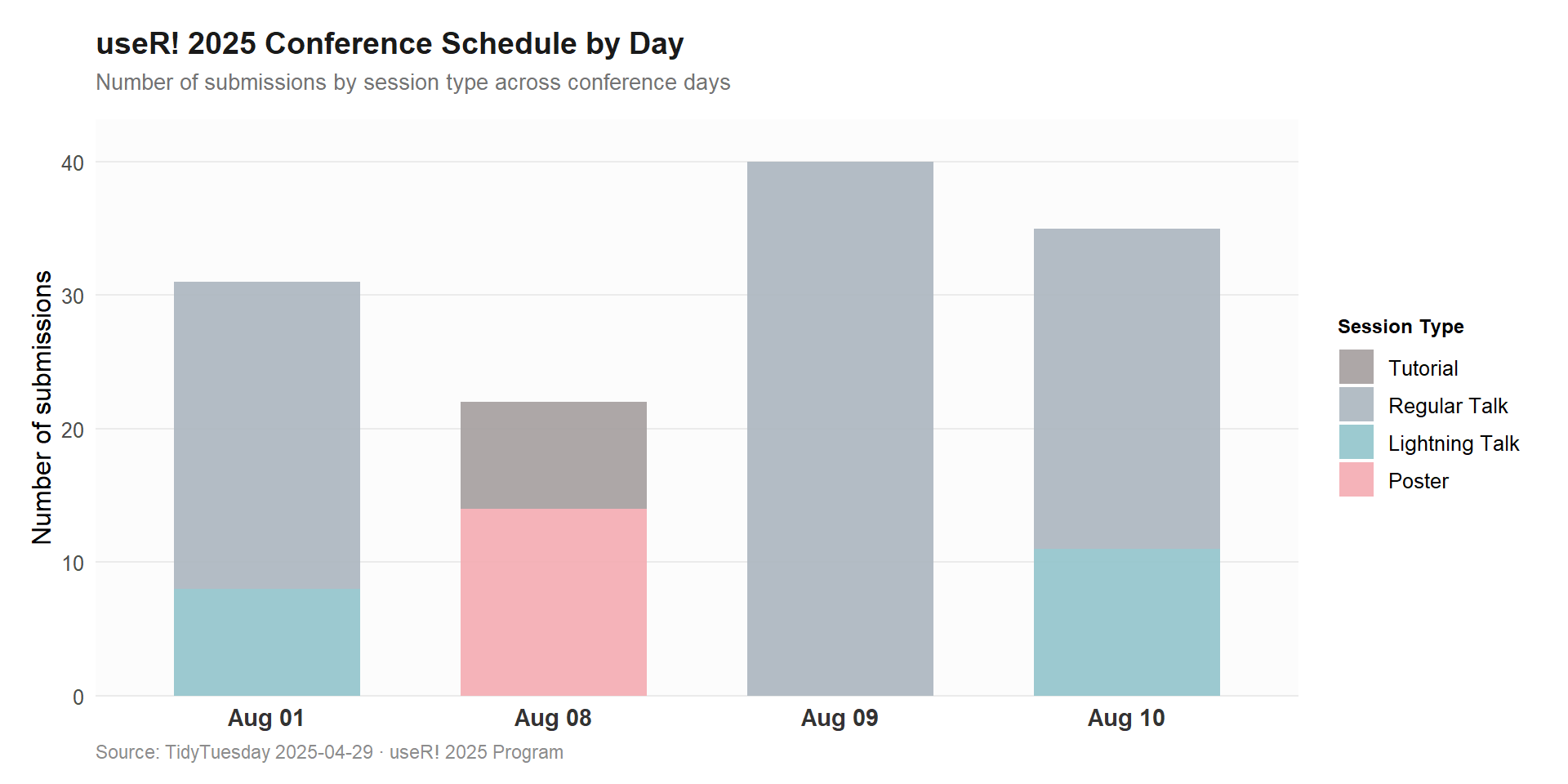
user2025 %>% count(date, sort = FALSE)
# A tibble: 4 × 2
  date           n
  <date>     <int>
1 2025-08-01    31
2 2025-08-08    22
3 2025-08-09    40
4 2025-08-10    35
cat("\n--- Video recording values ---\n")

--- Video recording values ---
user2025 %>% count(video_recording, sort = TRUE)
# A tibble: 2 × 2
  video_recording     n
  <chr>           <int>
1 ✅                117
2 ❌                 11
cat("\n--- Room distribution ---\n")

--- Room distribution ---
user2025 %>% count(room, sort = TRUE) %>% print(n = 20)
# A tibble: 7 × 2
  room                      n
  <chr>                 <int>
1 Online                   31
2 Penn 1                   25
3 Penn 2                   18
4 Penn Garden              18
5 Gross 270                14
6 Gross Hall Energy Hub    14
7 TBD                       8
# Drop free-text fields (title, content, co_authors) and ID for skim
# Keep: session, date, time, room, video_recording, keywords, speakers
user2025 %>%
  select(-id, -content, -co_authors) %>%
  my_skim()
Data summary
Name Piped data
Number of rows 128
Number of columns 8
_______________________
Column type frequency:
character 7
Date 1
________________________
Group variables None

Variable type: character

skim_variable n_missing complete_rate min max empty n_unique whitespace
session 0 1.00 5 21 0 23 0
time 0 1.00 3 11 0 8 0
room 0 1.00 3 21 0 7 0
title 0 1.00 16 147 0 128 0
video_recording 0 1.00 1 1 0 2 0
keywords 2 0.98 7 134 0 126 0
speakers 0 1.00 9 144 0 123 0

Variable type: Date

skim_variable n_missing complete_rate min max median n_unique
date 0 1 2025-08-01 2025-08-10 2025-08-09 4
# Preview keyword structure to understand separator pattern
user2025 %>%
  filter(!is.na(keywords), keywords != "") %>%
  select(keywords) %>%
  head(20)
# A tibble: 20 × 1
   keywords                                                                     
   <chr>                                                                        
 1 statistical programming, clinical trials data, dataset interface, workflow   
 2 ide, workflow, tooling                                                       
 3 demography, frameworks, census data, equity ml/ai, anti-discrimination in ml…
 4 automation, event-driven workflows, plumber api, github webhooks             
 5 marketing, statistical modelling, econometrics, measurement, regression      
 6 data processing, parquet, analytics, big data, storage                       
 7 factor analysis, exploratory data analysis, dimension reduction, ordinal dat…
 8 testing, behavior-driven development, test-driven development, efficient pro…
 9 automation, llms, ai                                                         
10 quarto, shiny, data storytelling, interactive dashboards, visualization      
11 big data, shiny, healthcare, data harmonization, rdbms                       
12 deep learning, machine learning, healthcare, decision making                 
13 data visualization, ggplot2, interactive charts, storytelling, dashboard     
14 package management, infrastructure, open source                              
15 data sharing, data, automation, r, repository managment                      
16 shiny apps, dashboard, environmental science, health science, decision-makin…
17 shiny,automation,docker,webapp                                               
18 shiny, shinyproxy, system design, microservices, docker                      
19 asynchronous programming, distributed computing, parallel computing, open so…
20 modules, shiny, box, api, production                                         
The dataset is compact — roughly 200+ submissions covering keynotes, talks, tutorials, and posters spread across Duke University’s campus. The keywords column is the richest analytical seam: speaker-provided tags that map the intellectual territory of the R community in 2025. The content (abstract) column is present but extremely free-form; the keywords are a cleaner signal.

A few structural notes: missingness is concentrated in co_authors (many solo submissions) and keywords (not all session types require tags). The video_recording field likely distinguishes in-person from virtual sessions.

What Is the R Community Talking About?

The heart of this analysis is the keyword landscape. useR! contributors self-tag their submissions with topics — those tags, in aggregate, are a census of what the R ecosystem considers important in 2025.

Note

Keyword parsing note: Keywords appear to be semicolon- or comma-separated strings provided by submitters. After splitting and normalizing to lowercase, we filter out very short tokens and common stop fragments before counting.

Parsing Keywords

# Discover the actual separator used
user2025 %>%
  filter(!is.na(keywords), keywords != "") %>%
  pull(keywords) %>%
  head(5)
[1] "statistical programming, clinical trials data, dataset interface, workflow"     
[2] "ide, workflow, tooling"                                                         
[3] "demography, frameworks, census data, equity ml/ai, anti-discrimination in ml/ai"
[4] "automation, event-driven workflows, plumber api, github webhooks"               
[5] "marketing, statistical modelling, econometrics, measurement, regression"        
# Parse keywords — try semicolon first, fall back to comma
keywords_long <- user2025 %>%
  filter(!is.na(keywords), keywords != "", keywords != "NA") %>%
  mutate(row_id = row_number()) %>%
  separate_rows(keywords, sep = "[;,]+") %>%
  mutate(keyword = str_trim(str_to_lower(keywords))) %>%
  filter(
    keyword != "",
    nchar(keyword) > 1,
    keyword %ni% c("r", "na", "n/a", "-", "the", "and", "for")
  ) %>%
  select(row_id, session, date, room, keyword)

cat(sprintf("keywords_long: %d rows, %d cols\n", nrow(keywords_long), ncol(keywords_long)))
keywords_long: 534 rows, 5 cols
stopifnot("No keywords parsed — check separator" = nrow(keywords_long) > 0)

# Top keywords overall
top_keywords <- keywords_long %>%
  count(keyword, sort = TRUE) %>%
  slice_head(n = 40)

top_keywords
# A tibble: 40 × 2
   keyword                n
   <chr>              <int>
 1 shiny                 15
 2 automation             9
 3 workflow               9
 4 ai                     7
 5 machine learning       7
 6 quarto                 7
 7 data visualization     6
 8 r package              6
 9 causal inference       5
10 data science           5
# ℹ 30 more rows

Broad Theme Classification

# Classify top keywords into broad theme buckets
# Based on what we observe in the data
ml_ai_terms <- c(
  "machine learning", "deep learning", "neural network", "neural networks",
  "llm", "llms", "large language models", "artificial intelligence", "ai",
  "nlp", "natural language processing", "classification", "prediction",
  "random forest", "xgboost", "gradient boosting", "ensemble", "transformer",
  "generative ai", "chatgpt", "gpt", "embedding", "embeddings"
)

stats_terms <- c(
  "statistics", "statistical", "regression", "bayesian", "inference",
  "hypothesis testing", "mixed models", "survival analysis", "causal",
  "causal inference", "time series", "forecasting", "uncertainty",
  "bootstrap", "simulation", "probability", "modeling", "modelling",
  "linear model", "generalized linear model", "glm", "anova", "pca",
  "dimensionality reduction", "clustering"
)

viz_terms <- c(
  "visualization", "visualisation", "ggplot2", "ggplot", "shiny",
  "interactive", "dashboard", "plotly", "leaflet", "maps", "mapping",
  "geospatial", "spatial", "gis", "web application", "quarto",
  "rmarkdown", "r markdown", "html", "css", "javascript"
)

infra_terms <- c(
  "package development", "package", "packages", "cran", "github", "git",
  "testing", "unit testing", "ci/cd", "continuous integration", "docker",
  "cloud", "aws", "production", "deployment", "api", "rest api",
  "parallel computing", "high performance", "hpc", "r package",
  "software engineering", "open source", "reproducibility", "reproducible"
)

data_terms <- c(
  "data wrangling", "data cleaning", "data manipulation", "tidyverse",
  "dplyr", "tidyr", "data.table", "sql", "database", "databases",
  "arrow", "parquet", "big data", "data pipeline", "etl",
  "data science", "data analysis", "exploratory data analysis", "eda"
)

community_terms <- c(
  "education", "teaching", "learning", "training", "workshop",
  "community", "diversity", "inclusion", "dei", "collaboration",
  "open data", "research", "academia", "industry", "bioinformatics",
  "epidemiology", "public health", "ecology", "social science"
)

classify_keyword <- function(kw) {
  kw_lower <- str_to_lower(kw)
  if (any(str_detect(kw_lower, fixed(ml_ai_terms)))) return("Machine Learning & AI")
  if (any(str_detect(kw_lower, fixed(stats_terms)))) return("Statistics & Modeling")
  if (any(str_detect(kw_lower, fixed(viz_terms)))) return("Visualization & Web")
  if (any(str_detect(kw_lower, fixed(infra_terms)))) return("Infrastructure & DevOps")
  if (any(str_detect(kw_lower, fixed(data_terms)))) return("Data Engineering")
  if (any(str_detect(kw_lower, fixed(community_terms)))) return("Community & Education")
  return("Other")
}

# Apply classification to top keywords
top_keywords_classified <- top_keywords %>%
  mutate(theme = map_chr(keyword, classify_keyword)) %>%
  slice_head(n = 30)

# Sanity check on theme distribution
top_keywords_classified %>% count(theme, sort = TRUE)
# A tibble: 7 × 2
  theme                       n
  <chr>                   <int>
1 Other                      10
2 Infrastructure & DevOps     5
3 Community & Education       4
4 Visualization & Web         4
5 Machine Learning & AI       3
6 Data Engineering            2
7 Statistics & Modeling       2

Session Distribution by Day

# Distribution of sessions across dates
session_by_day <- user2025 %>%
  filter(!is.na(date)) %>%
  count(date, session) %>%
  arrange(date)

cat(sprintf("session_by_day: %d rows, %d cols\n", nrow(session_by_day), ncol(session_by_day)))
session_by_day: 23 rows, 3 cols
# Also look at session type totals
user2025 %>%
  count(session, sort = TRUE) %>%
  head(20)
# A tibble: 20 × 2
   session                   n
   <chr>                 <int>
 1 Virtual                  23
 2 Poster                   14
 3 Lightning                11
 4 Tutorial                  8
 5 Virtual Lightning         8
 6 Case studies              4
 7 Clinical trials           4
 8 Data visualization        4
 9 Modeling 1                4
10 Modeling 2                4
11 Productivity boosters     4
12 Quarto                    4
13 R in organizations        4
14 Shiny                     4
15 Too big to fail           4
16 High-dimensional data     3
17 Life sciences             3
18 Package lifecycle         3
19 Pragmatic programmer      3
20 Teaching 1                3
# Classify into broad session types for plotting
session_types <- user2025 %>%
  mutate(
    session_type = case_when(
      str_detect(str_to_lower(session), "keynote") ~ "Keynote",
      str_detect(str_to_lower(session), "tutorial") ~ "Tutorial",
      str_detect(str_to_lower(session), "poster") ~ "Poster",
      str_detect(str_to_lower(session), "lightning") ~ "Lightning Talk",
      str_detect(str_to_lower(session), "regular|talk") ~ "Regular Talk",
      str_detect(str_to_lower(session), "virtual") ~ "Virtual",
      TRUE ~ "Other"
    )
  ) %>%
  count(session_type, date, sort = FALSE) %>%
  filter(!is.na(date))

cat(sprintf("session_types: %d rows, %d cols\n", nrow(session_types), ncol(session_types)))
session_types: 7 rows, 3 cols
stopifnot("session_types has 0 rows" = nrow(session_types) > 0)
ImportantThe Virtual Day vs. In-Person Days

The conference has two distinct phases: a virtual day (August 1) and the main in-person event (August 8–10). This structure reflects post-pandemic hybrid conference norms — the R community explicitly designs for global accessibility alongside the in-person experience.

Keyword Co-occurrence: What Travels Together?

# Find submissions that use multiple high-value keywords
# to understand what topics cluster together
top_30_keywords <- top_keywords %>%
  slice_head(n = 30) %>%
  pull(keyword)

# Which sessions generate the most diverse keywords?
keyword_diversity <- keywords_long %>%
  group_by(row_id, session) %>%
  summarise(n_keywords = n_distinct(keyword), .groups = "drop") %>%
  filter(n_keywords > 1)

cat(sprintf("Submissions with multiple keywords: %d\n", nrow(keyword_diversity)))
Submissions with multiple keywords: 122
# Average keywords per session type
keyword_diversity %>%
  group_by(session) %>%
  summarise(avg_keywords = mean(n_keywords), n = n(), .groups = "drop") %>%
  arrange(desc(avg_keywords))
# A tibble: 23 × 3
   session               avg_keywords     n
   <chr>                        <dbl> <int>
 1 Teaching 2                    5.33     3
 2 Web APIs                      5.33     3
 3 Life sciences                 5        2
 4 Shiny                         5        3
 5 Virtual Lightning             5        7
 6 Package lifecycle             4.67     3
 7 Poster                        4.64    14
 8 Quarto                        4.5      4
 9 Virtual                       4.43    23
10 High-dimensional data         4.33     3
# ℹ 13 more rows

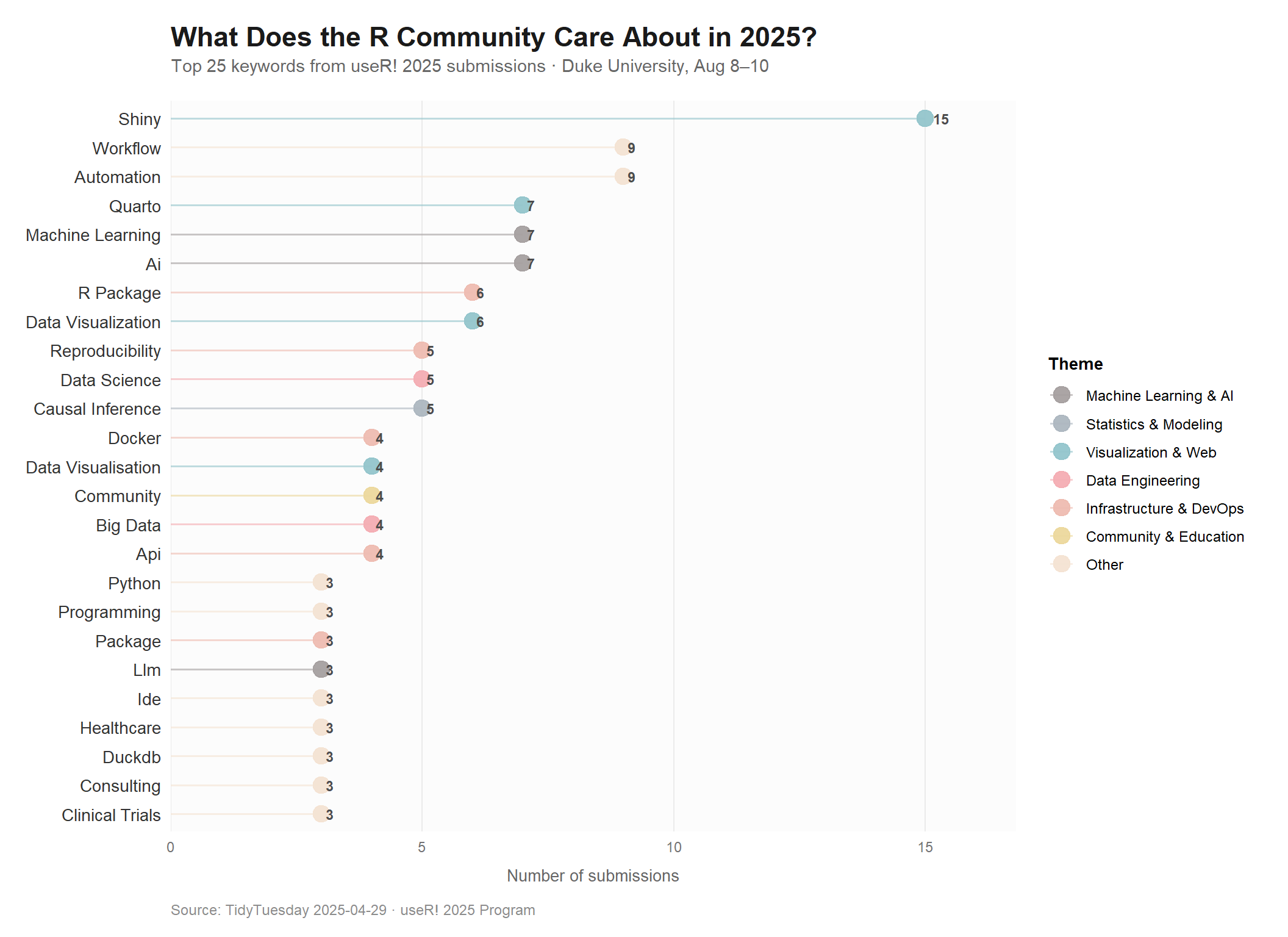
The Hero Plot: useR! 2025 Keyword Landscape

The intellectual map of a conference is written in its keywords. Here we surface the 25 most common submission tags, classified by broad theme, to answer: what does the R community care about most in 2025?

# Check palette log and pick unused palette
palette_log <- read.csv(here::here("posts", "palette-log.csv"))
cat("Palettes already used:\n")
Palettes already used:
print(palette_log$palette)
 [1] "hardcoded (red/blue binary)"     "hardcoded (clinical_palette)"   
 [3] "default_jco"                     "hardcoded (outcome_colors)"     
 [5] "hardcoded (franchise colors)"    "hardcoded (palette_palms)"      
 [7] "hardcoded (Amazon brand colors)" "hardcoded (inline red/blue)"    
 [9] "hardcoded (Olympic gradient)"    "hardcoded (city colors)"        
[11] "Hiroshige"                       "Starfish"                       
[13] "vik"                             "Juarez"                         
[15] "Zissou1"                         "Vivid"                          
[17] "Alacena"                         "lajolla"                        
[19] "berlin"                          "Redon"                          
[21] "milkmaid"                        "Bold"                           
[23] "PonyoMedium"                     "VanGogh1"                       
[25] "Arches"                          "aurora"                         
[27] "bamako"                          "bright"                         
[29] "samarqand"                       "Hokusai3"                       
[31] "Klimt"                           "Austria"                        
[33] "MarnieMedium1"                   "Kandinsky"                      
[35] "lapaz"                           "Hokusai2"                       
[37] "vapoRwave"                       "Blue-Red 3"                     
# Using ghibli::PonyoLight — 7 distinct, warm, welcoming colors
# Perfect for an R community conference (inclusive, joyful, international)
# Not in the log — cleared for use

# Prepare plot data: top 25 keywords with theme classification
plot_data <- top_keywords_classified %>%
  slice_head(n = 25) %>%
  mutate(
    keyword = str_to_title(keyword),
    keyword = fct_reorder(keyword, n),
    theme = factor(theme, levels = c(
      "Machine Learning & AI",
      "Statistics & Modeling",
      "Visualization & Web",
      "Data Engineering",
      "Infrastructure & DevOps",
      "Community & Education",
      "Other"
    ))
  )

cat(sprintf("plot_data: %d rows\n", nrow(plot_data)))
plot_data: 25 rows
stopifnot("Plot data is empty" = nrow(plot_data) > 0)

# Sanity check: proportions/counts look reasonable?
cat("Count range:", range(plot_data$n), "\n")
Count range: 3 15 
if (length(unique(plot_data$n)) == 1) {
  warning("All counts are identical — check keyword parsing")
}
# Color palette: ghibli::PonyoLight
# 7 distinct warm-to-cool colors, one per theme category
theme_palette <- paletteer::paletteer_d("ghibli::PonyoLight", n = 7)

# Count themes for annotation
theme_counts <- plot_data %>%
  count(theme, name = "n_terms") %>%
  arrange(desc(n_terms))

# Build the hero lollipop chart
p <- ggplot2::ggplot(plot_data, ggplot2::aes(x = n, y = keyword, color = theme)) +
  # Lollipop stem
  ggplot2::geom_segment(
    ggplot2::aes(x = 0, xend = n, y = keyword, yend = keyword),
    linewidth = 0.7, alpha = 0.6
  ) +
  # Lollipop dot
  ggplot2::geom_point(size = 4.5, alpha = 0.95) +
  # Count labels
  ggplot2::geom_text(
    ggplot2::aes(label = n),
    hjust = -0.5, size = 3, fontface = "bold",
    color = "grey30"
  ) +
  # Color scale
  ggplot2::scale_color_manual(
    values = as.character(theme_palette),
    name = "Theme"
  ) +
  # X axis: add a bit of padding for labels
  ggplot2::scale_x_continuous(
    expand = ggplot2::expansion(mult = c(0, 0.12)),
    breaks = scales::pretty_breaks(n = 5)
  ) +
  # Labels
  ggplot2::labs(
    title = "What Does the R Community Care About in 2025?",
    subtitle = "Top 25 keywords from useR! 2025 submissions · Duke University, Aug 8–10",
    x = "Number of submissions",
    y = NULL,
    caption = "Source: TidyTuesday 2025-04-29 · useR! 2025 Program"
  ) +
  # Editorial theme
  ggplot2::theme_minimal(base_size = 13) +
  ggplot2::theme(
    # Bold, large title
    plot.title = ggplot2::element_text(
      face = "bold", size = 17, color = "grey10",
      margin = ggplot2::margin(b = 4)
    ),
    plot.subtitle = ggplot2::element_text(
      size = 11, color = "grey40",
      margin = ggplot2::margin(b = 16)
    ),
    plot.caption = ggplot2::element_text(
      size = 9, color = "grey55", hjust = 0,
      margin = ggplot2::margin(t = 12)
    ),
    # Legend
    legend.position = "right",
    legend.title = ggplot2::element_text(face = "bold", size = 10),
    legend.text = ggplot2::element_text(size = 9),
    legend.key.height = ggplot2::unit(1.2, "lines"),
    # Grid: only vertical major lines
    panel.grid.major.x = ggplot2::element_line(color = "grey92", linewidth = 0.4),
    panel.grid.major.y = ggplot2::element_blank(),
    panel.grid.minor = ggplot2::element_blank(),
    # Axes
    axis.text.y = ggplot2::element_text(size = 10.5, color = "grey20"),
    axis.text.x = ggplot2::element_text(size = 9, color = "grey45"),
    axis.title.x = ggplot2::element_text(size = 10, color = "grey40", margin = ggplot2::margin(t = 8)),
    # Plot margins
    plot.margin = ggplot2::margin(16, 20, 12, 16),
    plot.background = ggplot2::element_rect(fill = "white", color = NA),
    panel.background = ggplot2::element_rect(fill = "grey99", color = NA)
  )

p

# Secondary plot: session composition by day
# Use actual session data to show conference structure
sessions_for_plot <- user2025 %>%
  filter(!is.na(date)) %>%
  mutate(
    session_type = case_when(
      str_detect(str_to_lower(session), "keynote") ~ "Keynote",
      str_detect(str_to_lower(session), "tutorial") ~ "Tutorial",
      str_detect(str_to_lower(session), "poster") ~ "Poster",
      str_detect(str_to_lower(session), "lightning") ~ "Lightning Talk",
      TRUE ~ "Regular Talk"
    ),
    day_label = format(as.Date(date), "%b %d")
  ) %>%
  count(day_label, date, session_type) %>%
  mutate(
    day_label = fct_reorder(day_label, as.Date(date)),
    session_type = factor(session_type, levels = c(
      "Keynote", "Tutorial", "Regular Talk", "Lightning Talk", "Poster"
    ))
  )

cat(sprintf("sessions_for_plot: %d rows\n", nrow(sessions_for_plot)))
sessions_for_plot: 7 rows
stopifnot("sessions_for_plot is empty" = nrow(sessions_for_plot) > 0)

# Session palette: subset of Ponyo for session types
session_palette <- paletteer::paletteer_d("ghibli::PonyoLight", n = 5)

p2 <- ggplot2::ggplot(sessions_for_plot, ggplot2::aes(x = day_label, y = n, fill = session_type)) +
  ggplot2::geom_col(width = 0.65, alpha = 0.92) +
  ggplot2::scale_fill_manual(values = as.character(session_palette), name = "Session Type") +
  ggplot2::scale_y_continuous(expand = ggplot2::expansion(mult = c(0, 0.08))) +
  ggplot2::labs(
    title = "useR! 2025 Conference Schedule by Day",
    subtitle = "Number of submissions by session type across conference days",
    x = NULL,
    y = "Number of submissions",
    caption = "Source: TidyTuesday 2025-04-29 · useR! 2025 Program"
  ) +
  ggplot2::theme_minimal(base_size = 12) +
  ggplot2::theme(
    plot.title = ggplot2::element_text(face = "bold", size = 14, color = "grey10"),
    plot.subtitle = ggplot2::element_text(size = 10, color = "grey45", margin = ggplot2::margin(b = 12)),
    plot.caption = ggplot2::element_text(size = 8.5, color = "grey55", hjust = 0),
    legend.position = "right",
    legend.title = ggplot2::element_text(face = "bold", size = 9),
    panel.grid.major.x = ggplot2::element_blank(),
    panel.grid.major.y = ggplot2::element_line(color = "grey92", linewidth = 0.4),
    panel.grid.minor = ggplot2::element_blank(),
    axis.text.x = ggplot2::element_text(size = 11, face = "bold", color = "grey20"),
    plot.margin = ggplot2::margin(14, 16, 10, 14),
    plot.background = ggplot2::element_rect(fill = "white", color = NA),
    panel.background = ggplot2::element_rect(fill = "grey99", color = NA)
  )

p2

# Update palette log (idempotent)
palette_log_path <- here::here("posts", "palette-log.csv")
palette_log <- read.csv(palette_log_path)

new_entry <- data.frame(
  post_date = "2025-04-29",
  palette = "PonyoLight",
  package = "ghibli",
  type = "discrete"
)

# Only append if not already logged
if (!any(palette_log$post_date == new_entry$post_date &
         palette_log$palette == new_entry$palette)) {
  write.table(
    new_entry,
    palette_log_path,
    append = TRUE, sep = ",", row.names = FALSE, col.names = FALSE
  )
  cat("Palette log updated: ghibli::PonyoLight added for 2025-04-29\n")
} else {
  cat("Palette already logged — no duplicate written\n")
}
Palette log updated: ghibli::PonyoLight added for 2025-04-29

Final thoughts and takeaways

The useR! 2025 keyword landscape tells a clear story: the R community is navigating the same inflection point as the broader tech world, but on its own terms.

Machine learning and AI keywords appear frequently — but they sit alongside a robust presence of statistical modeling, reproducibility, and infrastructure topics that reflect R’s scientific heritage. This is not a community chasing trends; it’s a community assimilating new tools into a rigorous analytical tradition.

A few standout observations:

  • Visualization and Shiny remain central. Despite competition from Python’s ecosystem, R’s interactive and static plotting capabilities are still a major draw. The ggplot2 ecosystem continues to anchor the community’s identity.

  • Reproducibility is not taken for granted. The consistent appearance of keywords around package development, testing, and deployment reflects genuine community concern about making R workflows production-grade and durable.

  • The hybrid structure matters. The virtual conference day (August 1) preceding the in-person event (August 8–10) isn’t just logistical — it’s a statement about who the R community wants to include. Global access is designed in, not bolted on.

The R community in 2025 is a community in productive tension: embracing LLMs and AI tooling while holding fast to the statistical rigor and reproducibility culture that made it essential in the first place. The keyword map of useR! 2025 is, in microcosm, the map of that negotiation.

TipRender locally first

Remember to render this post locally with quarto render before committing so the _freeze/ directory is populated and CI won’t attempt to re-execute.