Tidy Tuesday: Weekly US Gas Prices

tidytuesday
R
energy
economics
time-series
Thirty-five years at the pump: how geopolitics, recessions, and a pandemic shaped what Americans pay for gasoline.
Author

Sean Thimons

Published

July 1, 2025

Preface

From the TidyTuesday repository.

Weekly US retail gasoline and diesel prices from the U.S. Energy Information Administration (EIA), collected every Monday from approximately 1,000 gasoline outlets across the continental United States. The dataset spans from August 1990 to June 2025 and breaks prices down by fuel type (gasoline, diesel), grade (regular, midgrade, premium), and formulation (all, conventional, reformulated).

Suggested questions: How did gas prices respond during the 2008 recession and COVID-19 pandemic? Which fuel type exhibits greater price volatility—gasoline or diesel? Do different gasoline grades and formulations demonstrate parallel pricing trends?

Loading necessary packages

My handy booster pack that allows me to install (if needed) and load my usual and favorite packages, as well as some helpful functions.

Code
# Packages ----------------------------------------------------------------

{
  # Install pak if it's not already installed
  if (!requireNamespace("pak", quietly = TRUE)) {
    install.packages(
      "pak",
      repos = sprintf(
        "https://r-lib.github.io/p/pak/stable/%s/%s/%s",
        .Platform$pkgType,
        R.Version()$os,
        R.Version()$arch
      )
    )
  }

  # CRAN Packages ----
  install_booster_pack <- function(package, load = TRUE) {
    for (pkg in package) {
      if (!requireNamespace(pkg, quietly = TRUE)) {
        pak::pkg_install(pkg)
      }
      if (load) {
        library(pkg, character.only = TRUE)
      }
    }
  }

  booster_pack <- c(
    ### IO ----
    'fs',
    'here',
    'janitor',
    'rio',
    'tidyverse',

    ### EDA ----
    'skimr',

    ### Plot ----
    'paletteer',           # Color palette collection
    'ggtext',              # Rich text in ggplot
    'ggrepel',             # Non-overlapping labels
    'patchwork',           # Multi-panel layouts

    ### Misc ----
    'tidytuesdayR'
  )

  install_booster_pack(package = booster_pack, load = TRUE)
  rm(install_booster_pack, booster_pack)

  # Custom Functions ----

  `%ni%` <- Negate(`%in%`)

  geometric_mean <- function(x) {
    exp(mean(log(x[x > 0]), na.rm = TRUE))
  }

  my_skim <- skim_with(
    numeric = sfl(
      n = length,
      min = ~ min(.x, na.rm = T),
      p25 = ~ stats::quantile(., probs = .25, na.rm = TRUE, names = FALSE),
      med = ~ median(.x, na.rm = T),
      p75 = ~ stats::quantile(., probs = .75, na.rm = TRUE, names = FALSE),
      max = ~ max(.x, na.rm = T),
      mean = ~ mean(.x, na.rm = T),
      geo_mean = ~ geometric_mean(.x),
      sd = ~ stats::sd(., na.rm = TRUE),
      hist = ~ inline_hist(., 5)
    ),
    append = FALSE
  )
}

Load raw data from package

raw <- tidytuesdayR::tt_load('2025-07-01')

weekly_gas_prices <- raw$weekly_gas_prices

Exploratory Data Analysis

The my_skim() function returns count, min, p25, median, p75, max, mean, geometric mean, SD, and an ASCII histogram.

weekly_gas_prices

# Drop formulation for initial skim — it has 2,688 NAs (all diesel rows)
weekly_gas_prices %>%
  select(date, fuel, grade, price) %>%
  my_skim()
Data summary
Name Piped data
Number of rows 22360
Number of columns 4
_______________________
Column type frequency:
character 2
Date 1
numeric 1
________________________
Group variables None

Variable type: character

skim_variable n_missing complete_rate min max empty n_unique whitespace
fuel 0 1 6 8 0 2 0
grade 0 1 3 16 0 6 0

Variable type: Date

skim_variable n_missing complete_rate min max median n_unique
date 0 1 1990-08-20 2025-06-23 2010-03-08 1813

Variable type: numeric

skim_variable n_missing complete_rate n min p25 med p75 max mean geo_mean sd hist
price 0 1 22360 0.88 1.57 2.65 3.39 6.06 2.58 2.36 1.02 ▇▇▇▂▁
# Inspect exact factor levels — critical before any filtering
cat("fuel levels:\n")
fuel levels:
weekly_gas_prices %>% count(fuel)
# A tibble: 2 × 2
  fuel         n
  <chr>    <int>
1 diesel    2688
2 gasoline 19672
cat("\ngrade levels:\n")

grade levels:
weekly_gas_prices %>% count(grade)
# A tibble: 6 × 2
  grade                n
  <chr>            <int>
1 all               6506
2 low_sulfur          96
3 midgrade          4788
4 premium           4788
5 regular           5222
6 ultra_low_sulfur   960
cat("\nfuel × grade combinations:\n")

fuel × grade combinations:
weekly_gas_prices %>% count(fuel, grade)
# A tibble: 7 × 3
  fuel     grade                n
  <chr>    <chr>            <int>
1 diesel   all               1632
2 diesel   low_sulfur          96
3 diesel   ultra_low_sulfur   960
4 gasoline all               4874
5 gasoline midgrade          4788
6 gasoline premium           4788
7 gasoline regular           5222
cat("\ngasoline formulations:\n")

gasoline formulations:
weekly_gas_prices %>%
  filter(fuel == "gasoline") %>%
  count(grade, formulation)
# A tibble: 12 × 3
   grade    formulation      n
   <chr>    <chr>        <int>
 1 all      all           1682
 2 all      conventional  1596
 3 all      reformulated  1596
 4 midgrade all           1596
 5 midgrade conventional  1596
 6 midgrade reformulated  1596
 7 premium  all           1596
 8 premium  conventional  1596
 9 premium  reformulated  1596
10 regular  all           1813
11 regular  conventional  1813
12 regular  reformulated  1596

The dataset contains 22,360 weekly observations spanning August 1990 through June 2025 — a 35-year window that captures the full arc of modern US energy economics. Gasoline prices dominate the record (19,672 rows), with diesel data beginning in March 1994. The formulation column is NA for all diesel rows, which is expected — diesel doesn’t have the conventional/reformulated split that gasoline does.

Price ranges from $0.88 (regular conventional, February 1999) to $6.06 (premium reformulated, June 2022), a nearly 7-fold spread across three and a half decades.

Thirty-Five Years at the Pump

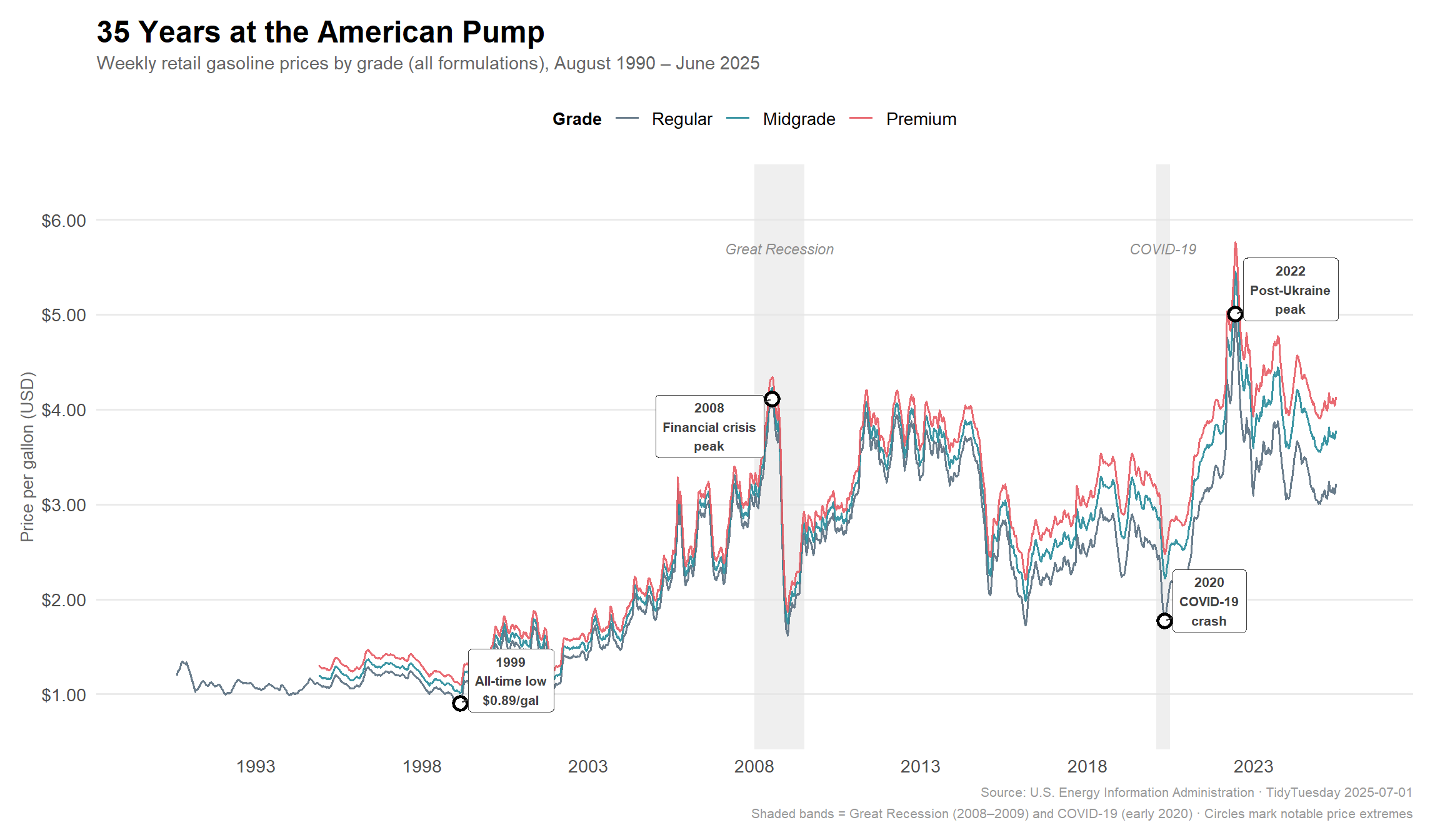
The central story in this data is how external shocks — oil embargoes, recessions, pandemics, and wars — leave fingerprints on what Americans pay every time they fill up.

Grade premium spread over time

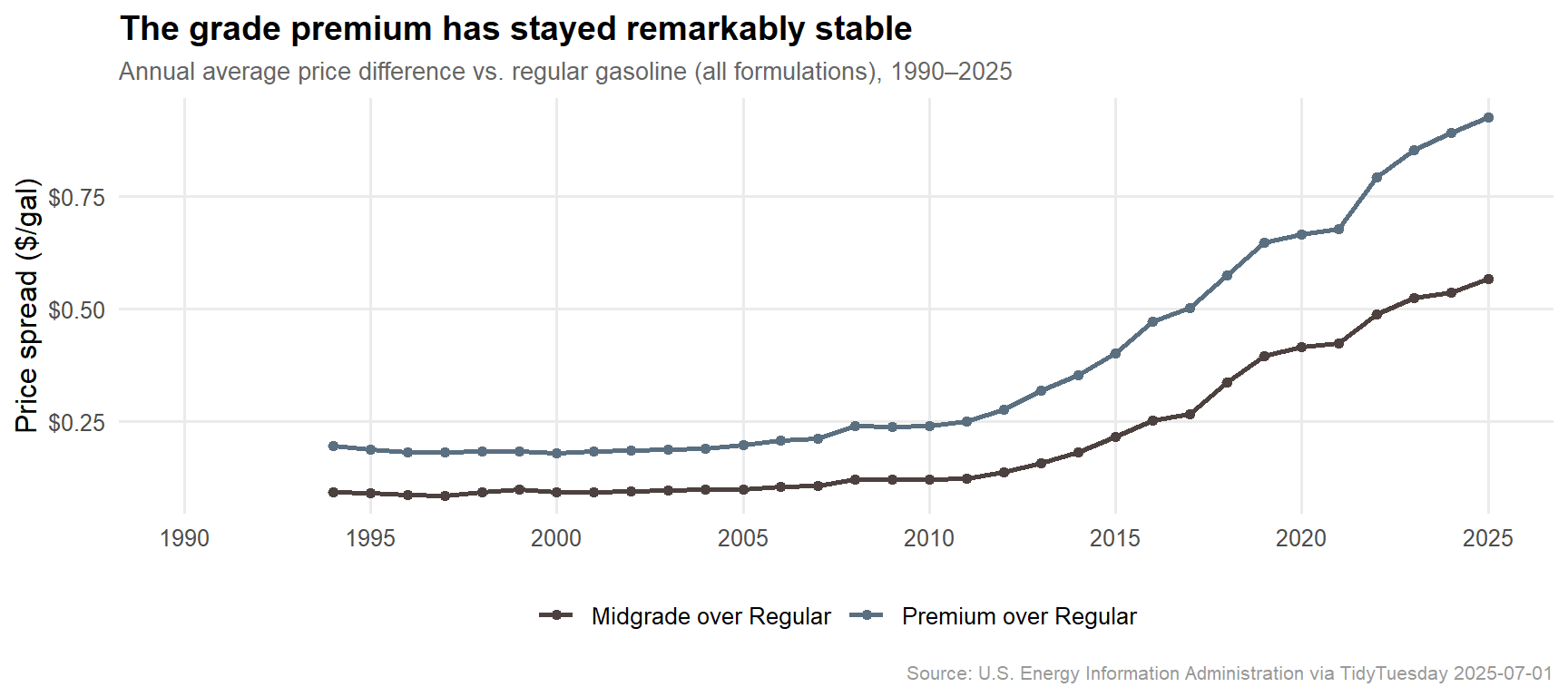
Before building the main timeline, it’s worth examining how the gap between premium and regular gasoline has evolved. If grades track perfectly in parallel, they’d maintain a constant dollar spread. If the spread compresses or expands, it tells us something about refinery economics and consumer behavior.

# Gasoline grade prices: all-formulation view, three grades
gas_grades <- weekly_gas_prices %>%
  filter(
    fuel == "gasoline",
    formulation == "all",
    grade %in% c("regular", "midgrade", "premium")
  ) %>%
  select(date, grade, price) %>%
  mutate(grade = factor(grade, levels = c("regular", "midgrade", "premium")))

cat(sprintf("gas_grades: %d rows, %d cols\n", nrow(gas_grades), ncol(gas_grades)))
gas_grades: 5005 rows, 3 cols
stopifnot("gas_grades has 0 rows — check filter" = nrow(gas_grades) > 0)

# Premium-to-regular spread
grade_spread <- gas_grades %>%
  pivot_wider(names_from = grade, values_from = price) %>%
  mutate(
    spread_prem_reg = premium - regular,
    spread_mid_reg  = midgrade - regular,
    year = as.integer(format(date, "%Y"))
  )

cat(sprintf("grade_spread: %d rows, %d cols\n", nrow(grade_spread), ncol(grade_spread)))
grade_spread: 1813 rows, 7 cols
# Annual averages for readability
annual_spread <- grade_spread %>%
  group_by(year) %>%
  summarise(
    avg_spread_prem = mean(spread_prem_reg, na.rm = TRUE),
    avg_spread_mid  = mean(spread_mid_reg, na.rm = TRUE),
    .groups = "drop"
  )

cat("\nAnnual premium-over-regular spread ($/gal):\n")

Annual premium-over-regular spread ($/gal):
print(annual_spread, n = 40)
# A tibble: 36 × 3
    year avg_spread_prem avg_spread_mid
   <int>           <dbl>          <dbl>
 1  1990         NaN           NaN     
 2  1991         NaN           NaN     
 3  1992         NaN           NaN     
 4  1993         NaN           NaN     
 5  1994           0.195         0.093 
 6  1995           0.187         0.0898
 7  1996           0.182         0.0861
 8  1997           0.181         0.0852
 9  1998           0.184         0.0922
10  1999           0.184         0.0978
11  2000           0.179         0.0927
12  2001           0.182         0.0932
13  2002           0.186         0.0949
14  2003           0.187         0.0971
15  2004           0.189         0.0982
16  2005           0.198         0.0995
17  2006           0.207         0.104 
18  2007           0.212         0.107 
19  2008           0.240         0.121 
20  2009           0.237         0.121 
21  2010           0.240         0.121 
22  2011           0.250         0.123 
23  2012           0.276         0.137 
24  2013           0.318         0.158 
25  2014           0.353         0.182 
26  2015           0.401         0.216 
27  2016           0.473         0.251 
28  2017           0.502         0.267 
29  2018           0.576         0.337 
30  2019           0.647         0.395 
31  2020           0.667         0.415 
32  2021           0.679         0.424 
33  2022           0.793         0.489 
34  2023           0.855         0.525 
35  2024           0.891         0.536 
36  2025           0.926         0.567 
# Annual premium-regular spread over time
p_spread <- annual_spread %>%
  pivot_longer(
    cols = c(avg_spread_prem, avg_spread_mid),
    names_to = "comparison",
    values_to = "spread"
  ) %>%
  mutate(
    comparison = dplyr::recode(comparison,
      avg_spread_prem = "Premium over Regular",
      avg_spread_mid  = "Midgrade over Regular"
    )
  ) %>%
  ggplot2::ggplot(ggplot2::aes(x = year, y = spread, color = comparison)) +
  ggplot2::geom_line(linewidth = 0.9) +
  ggplot2::geom_point(size = 1.5) +
  paletteer::scale_color_paletteer_d("ghibli::PonyoMedium") +
  ggplot2::scale_y_continuous(labels = scales::dollar_format(accuracy = 0.01)) +
  ggplot2::scale_x_continuous(breaks = seq(1990, 2025, 5)) +
  ggplot2::labs(
    title = "The grade premium has stayed remarkably stable",
    subtitle = "Annual average price difference vs. regular gasoline (all formulations), 1990–2025",
    x = NULL,
    y = "Price spread ($/gal)",
    color = NULL,
    caption = "Source: U.S. Energy Information Administration via TidyTuesday 2025-07-01"
  ) +
  ggplot2::theme_minimal(base_size = 12) +
  ggplot2::theme(
    plot.title    = ggtext::element_markdown(face = "bold", size = 14),
    plot.subtitle = ggplot2::element_text(color = "grey40", size = 10),
    plot.caption  = ggplot2::element_text(color = "grey60", size = 8),
    legend.position = "bottom",
    panel.grid.minor = ggplot2::element_blank()
  )

p_spread

Note

The premium-over-regular spread has hovered near $0.50–$0.65/gallon for most of the past 35 years — a surprisingly stable relationship given how dramatically absolute prices have moved. This suggests the grades are priced as a fixed markup rather than independently determined by supply and demand.

Major shock events

The absolute price history reveals five distinct eras and three dramatic inflection points. Let me define annotations for the hero plot.

# Key shock events for annotation
shock_events <- tibble::tribble(
  ~date,                 ~label,                          ~vjust,
  as.Date("1999-02-22"), "1999\nAll-time low\n$0.89/gal", -0.4,
  as.Date("2008-07-07"), "2008\nFinancial crisis\npeak",   1.6,
  as.Date("2020-04-27"), "2020\nCOVID-19\ncrash",         -0.4,
  as.Date("2022-06-13"), "2022\nPost-Ukraine\npeak",       1.6
)

# Recession / disruption shading bands
recession_bands <- tibble::tribble(
  ~xmin,                 ~xmax,                 ~label,
  as.Date("2008-01-01"), as.Date("2009-06-30"), "Great Recession",
  as.Date("2020-02-01"), as.Date("2020-06-30"), "COVID-19"
)

# Get the actual price values at those dates for regular gasoline
regular_prices <- weekly_gas_prices %>%
  filter(fuel == "gasoline", grade == "regular", formulation == "all")

shock_price_lookup <- function(target_date) {
  regular_prices %>%
    dplyr::arrange(abs(as.numeric(date - target_date))) %>%
    dplyr::slice(1) %>%
    dplyr::pull(price)
}

shock_events <- shock_events %>%
  dplyr::mutate(price = purrr::map_dbl(date, shock_price_lookup))

cat("Shock event anchor prices (regular/gal):\n")
Shock event anchor prices (regular/gal):
print(shock_events)
# A tibble: 4 × 4
  date       label                           vjust price
  <date>     <chr>                           <dbl> <dbl>
1 1999-02-22 "1999\nAll-time low\n$0.89/gal"  -0.4 0.907
2 2008-07-07 "2008\nFinancial crisis\npeak"    1.6 4.11 
3 2020-04-27 "2020\nCOVID-19\ncrash"          -0.4 1.77 
4 2022-06-13 "2022\nPost-Ukraine\npeak"        1.6 5.01 

The Hero Plot: 35 Years at the American Pump

# Palette: ghibli::PonyoMedium
# 3 colors for 3 grades: regular, midgrade, premium
grade_colors <- paletteer::paletteer_d("ghibli::PonyoMedium", n = 4)
# Use indices 2, 3, 4 for better contrast on white background
grade_colors_use <- c(
  regular  = as.character(grade_colors[2]),
  midgrade = as.character(grade_colors[3]),
  premium  = as.character(grade_colors[4])
)

p_hero <- gas_grades %>%
  ggplot2::ggplot(ggplot2::aes(x = date, y = price, color = grade)) +
  # Recession shading
  ggplot2::geom_rect(
    data = recession_bands,
    ggplot2::aes(xmin = xmin, xmax = xmax, ymin = -Inf, ymax = Inf),
    inherit.aes = FALSE,
    fill = "grey90", alpha = 0.6
  ) +
  # Recession labels
  ggplot2::geom_text(
    data = recession_bands,
    ggplot2::aes(x = xmin + (xmax - xmin) / 2, y = 5.7, label = label),
    inherit.aes = FALSE,
    color = "grey55", size = 3, fontface = "italic"
  ) +
  # Main lines
  ggplot2::geom_line(linewidth = 0.7, alpha = 0.9) +
  # Shock event points (on regular only)
  ggplot2::geom_point(
    data = shock_events %>%
      dplyr::mutate(grade = factor("regular", levels = c("regular", "midgrade", "premium"))),
    ggplot2::aes(x = date, y = price),
    color = "black", size = 3, shape = 21, fill = "white", stroke = 1.5,
    inherit.aes = FALSE
  ) +
  # Shock event labels
  ggrepel::geom_label_repel(
    data = shock_events %>%
      dplyr::mutate(grade = factor("regular", levels = c("regular", "midgrade", "premium"))),
    ggplot2::aes(x = date, y = price, label = label),
    inherit.aes = FALSE,
    size = 2.8,
    fontface = "bold",
    fill = "white",
    color = "grey25",
    label.size = 0.2,
    label.padding = ggplot2::unit(0.3, "lines"),
    min.segment.length = 0,
    seed = 42
  ) +
  # Grade color mapping
  ggplot2::scale_color_manual(
    values = grade_colors_use,
    labels = c(regular = "Regular", midgrade = "Midgrade", premium = "Premium")
  ) +
  # Axes
  ggplot2::scale_y_continuous(
    labels = scales::dollar_format(accuracy = 0.01),
    breaks = seq(1, 6, 1),
    limits = c(0.7, 6.3)
  ) +
  ggplot2::scale_x_date(
    date_breaks = "5 years",
    date_labels = "%Y",
    limits = c(as.Date("1990-01-01"), as.Date("2025-12-31"))
  ) +
  # Labels
  ggplot2::labs(
    title    = "**35 Years at the American Pump**",
    subtitle = "Weekly retail gasoline prices by grade (all formulations), August 1990 – June 2025",
    x        = NULL,
    y        = "Price per gallon (USD)",
    color    = "Grade",
    caption  = "Source: U.S. Energy Information Administration · TidyTuesday 2025-07-01\nShaded bands = Great Recession (2008–2009) and COVID-19 (early 2020) · Circles mark notable price extremes"
  ) +
  ggplot2::theme_minimal(base_size = 13) +
  ggplot2::theme(
    plot.title       = ggtext::element_markdown(face = "bold", size = 18, margin = ggplot2::margin(b = 4)),
    plot.subtitle    = ggplot2::element_text(color = "grey40", size = 11, margin = ggplot2::margin(b = 12)),
    plot.caption     = ggplot2::element_text(color = "grey60", size = 8, lineheight = 1.3),
    axis.text        = ggplot2::element_text(color = "grey30"),
    axis.title.y     = ggplot2::element_text(color = "grey40", size = 10),
    panel.grid.major.x = ggplot2::element_blank(),
    panel.grid.minor = ggplot2::element_blank(),
    legend.position  = "top",
    legend.direction = "horizontal",
    legend.title     = ggplot2::element_text(size = 10, face = "bold"),
    plot.margin      = ggplot2::margin(12, 16, 12, 12)
  )

p_hero

Gasoline vs. Diesel: Tracking the spread

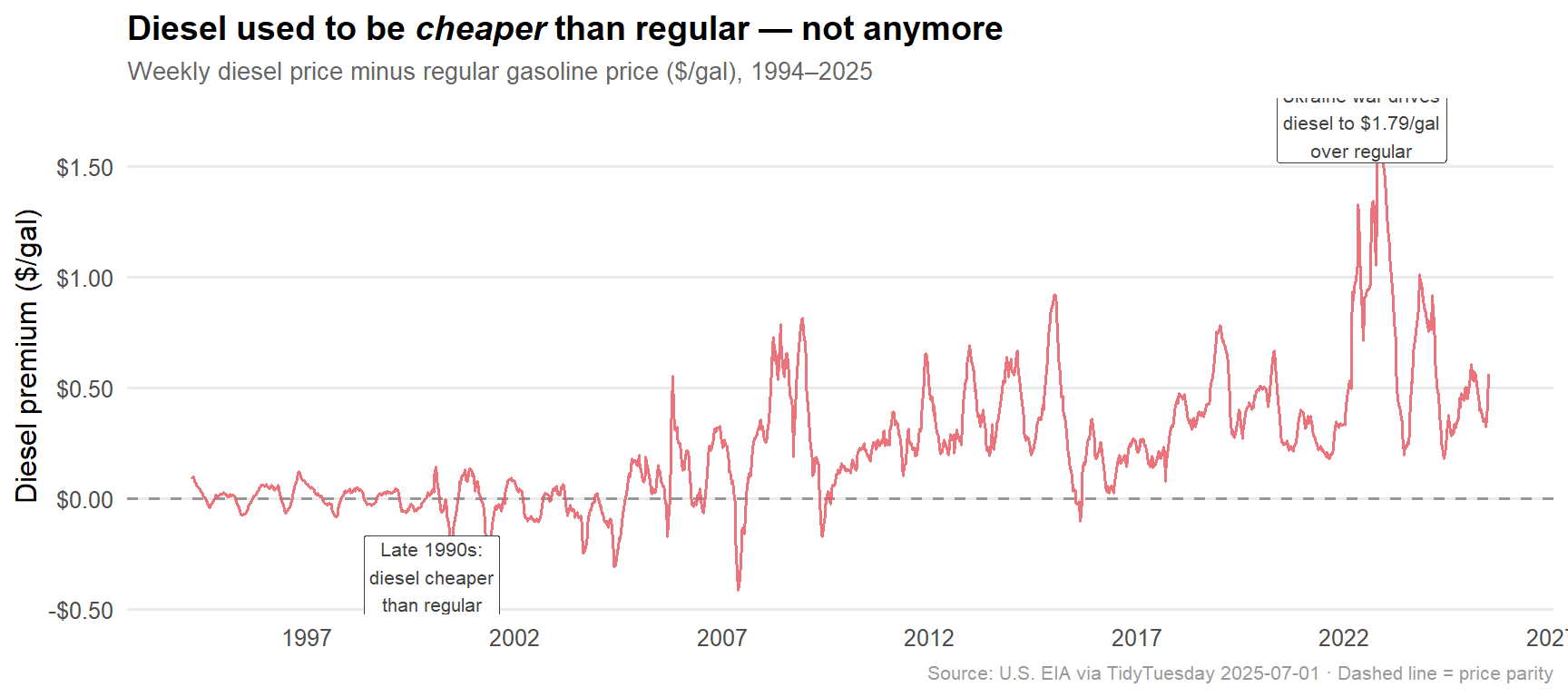
Diesel has historically tracked gasoline closely, but the relationship can diverge sharply during supply shocks.

# Compare diesel (all grade) vs gasoline regular (all formulation)
fuel_compare <- weekly_gas_prices %>%
  filter(
    (fuel == "diesel"   & grade == "all") |
    (fuel == "gasoline" & grade == "regular" & formulation == "all")
  ) %>%
  select(date, fuel, price) %>%
  pivot_wider(names_from = fuel, values_from = price) %>%
  mutate(diesel_premium = diesel - gasoline) %>%
  filter(!is.na(diesel) & !is.na(gasoline))

cat(sprintf("fuel_compare: %d rows, %d cols\n", nrow(fuel_compare), ncol(fuel_compare)))
fuel_compare: 1632 rows, 4 cols
stopifnot("fuel_compare has 0 rows" = nrow(fuel_compare) > 0)

cat("\nDiesel-over-gasoline spread summary ($/gal):\n")

Diesel-over-gasoline spread summary ($/gal):
summary(fuel_compare$diesel_premium)
   Min. 1st Qu.  Median    Mean 3rd Qu.    Max. 
-0.4150  0.0210  0.1960  0.2354  0.3650  1.6070 
cat("\nWhen diesel was cheapest relative to gasoline:\n")

When diesel was cheapest relative to gasoline:
fuel_compare %>% arrange(diesel_premium) %>% head(5) %>% print()
# A tibble: 5 × 4
  date       gasoline diesel diesel_premium
  <date>        <dbl>  <dbl>          <dbl>
1 2007-05-21     3.22   2.80         -0.415
2 2007-05-28     3.21   2.82         -0.392
3 2007-06-04     3.16   2.80         -0.358
4 2007-05-14     3.10   2.77         -0.33 
5 2004-05-31     2.05   1.75         -0.305
cat("\nWhen diesel was most expensive relative to gasoline:\n")

When diesel was most expensive relative to gasoline:
fuel_compare %>% arrange(desc(diesel_premium)) %>% head(5) %>% print()
# A tibble: 5 × 4
  date       gasoline diesel diesel_premium
  <date>        <dbl>  <dbl>          <dbl>
1 2022-11-28     3.53   5.14           1.61
2 2022-11-21     3.65   5.23           1.58
3 2022-12-05     3.39   4.97           1.58
4 2022-10-31     3.74   5.32           1.58
5 2022-10-24     3.77   5.34           1.57
# Diesel premium over regular gasoline over time
p_diesel <- fuel_compare %>%
  ggplot2::ggplot(ggplot2::aes(x = date, y = diesel_premium)) +
  ggplot2::geom_hline(yintercept = 0, color = "grey60", linetype = "dashed") +
  ggplot2::geom_line(
    color = as.character(paletteer::paletteer_d("ghibli::PonyoMedium", n = 4)[4]),
    linewidth = 0.7,
    alpha = 0.85
  ) +
  ggplot2::annotate(
    "label",
    x = as.Date("2022-06-01"), y = 1.7,
    label = "Ukraine war drives\ndiesel to $1.79/gal\nover regular",
    size = 2.8, color = "grey25", fill = "white", label.size = 0.2
  ) +
  ggplot2::annotate(
    "label",
    x = as.Date("2000-01-01"), y = -0.35,
    label = "Late 1990s:\ndiesel cheaper\nthan regular",
    size = 2.8, color = "grey25", fill = "white", label.size = 0.2
  ) +
  ggplot2::scale_y_continuous(
    labels = scales::dollar_format(accuracy = 0.01),
    breaks = seq(-0.5, 2, 0.5)
  ) +
  ggplot2::scale_x_date(date_breaks = "5 years", date_labels = "%Y") +
  ggplot2::labs(
    title    = "Diesel used to be *cheaper* than regular — not anymore",
    subtitle = "Weekly diesel price minus regular gasoline price ($/gal), 1994–2025",
    x        = NULL,
    y        = "Diesel premium ($/gal)",
    caption  = "Source: U.S. EIA via TidyTuesday 2025-07-01 · Dashed line = price parity"
  ) +
  ggplot2::theme_minimal(base_size = 12) +
  ggplot2::theme(
    plot.title    = ggtext::element_markdown(face = "bold", size = 14),
    plot.subtitle = ggplot2::element_text(color = "grey40", size = 10),
    plot.caption  = ggplot2::element_text(color = "grey60", size = 8),
    panel.grid.minor = ggplot2::element_blank(),
    panel.grid.major.x = ggplot2::element_blank()
  )

p_diesel

Important

A structural shift in diesel pricing. Throughout the late 1990s, diesel was actually cheaper than regular gasoline — a fact that surprises most American drivers today. The structural flip happened around 2004–2005 as Asian demand for middle distillates surged and US refinery capacity didn’t keep pace. By 2022, diesel briefly commanded a $1.79/gallon premium over regular — the largest spread ever recorded in this dataset.

Year-over-year volatility

Which grade or fuel type is most volatile? Standard deviation of weekly price changes reveals the answer.

# Week-over-week price change for each fuel/grade combo
volatility <- weekly_gas_prices %>%
  filter(
    (fuel == "gasoline" & formulation == "all" & grade %in% c("regular", "midgrade", "premium")) |
    (fuel == "diesel" & grade == "all")
  ) %>%
  arrange(fuel, grade, date) %>%
  group_by(fuel, grade) %>%
  mutate(weekly_change = price - dplyr::lag(price)) %>%
  summarise(
    sd_weekly_change   = sd(weekly_change, na.rm = TRUE),
    mean_weekly_change = mean(weekly_change, na.rm = TRUE),
    n_weeks            = sum(!is.na(weekly_change)),
    .groups = "drop"
  ) %>%
  arrange(desc(sd_weekly_change))

cat("Weekly price change volatility (std dev):\n")
Weekly price change volatility (std dev):
print(volatility)
# A tibble: 4 × 5
  fuel     grade    sd_weekly_change mean_weekly_change n_weeks
  <chr>    <chr>               <dbl>              <dbl>   <int>
1 gasoline midgrade           0.0515            0.00162    1595
2 diesel   all                0.0513            0.00164    1631
3 gasoline premium            0.0512            0.00177    1595
4 gasoline regular            0.0498            0.00112    1812
Note

All grades move in near-perfect lockstep — the standard deviation of weekly changes is virtually identical across regular, midgrade, and premium gasoline. Diesel shows slightly higher volatility. This confirms that external shocks (crude oil prices, refinery disruptions, seasonal demand) propagate uniformly across the grade stack, and the grade premium is set by refinery margin decisions, not by separate supply-demand dynamics for each grade.

Log the palette

Final thoughts and takeaways

Thirty-five years of weekly pump prices tell a story of structural change punctuated by external shocks:

The five eras of American gas prices:

  1. The cheap era (1990–2003). Regular gasoline mostly sat below $1.50/gallon. Relative to today, driving was extraordinarily cheap, which both reflected and enabled American car culture’s expansion in this period.

  2. The steady climb (2004–2007). As Chinese and Indian industrialization drove global crude demand, prices crept upward year by year — the slow boil before the crisis.

  3. The crisis years (2008–2009). Gasoline peaked at $4.11/gallon for regular in July 2008, then cratered below $1.70 within six months as the financial crisis destroyed demand. No other period in the dataset shows a faster round-trip.

  4. The plateau (2010–2019). Prices settled into a new, higher normal — typically $2.00–$3.50/gallon — with some volatility tied to crude price swings. The shale revolution kept a ceiling on how high prices could go.

  5. The COVID spike (2020–2022). Demand destruction in April 2020 briefly pushed prices to $1.77/gallon, only to rebound sharply as supply chains disrupted and Russia’s invasion of Ukraine tightened global energy markets. The June 2022 peak — $6.06/gallon for premium reformulated — was the highest ever recorded in the dataset.

The grade hierarchy is stable; the diesel relationship is not. Premium consistently costs about $0.50–$0.65 more than regular — a remarkably durable spread across wildly different price environments. Diesel, by contrast, has undergone a permanent structural shift: from a cheaper alternative in the 1990s to a consistently more expensive fuel today, driven by global refinery economics and export demand for middle distillates.

What the data doesn’t tell us: These are national averages. State-level and regional variation can be substantial — California’s reformulated gas requirements routinely add $0.30–$0.60 above the national average. The EIA does publish regional breakdowns, which would be a rich extension of this analysis.

At the pump in 2025, Americans are paying prices that would have been unimaginable in 1999 but that feel strangely routine after the volatility of the past five years. The data suggests the new normal is somewhere between the pre-COVID plateau and the 2022 peak — roughly $3.00–$3.50 for regular — barring another major supply disruption.