Tracking the global tuberculosis burden through WHO data — which regions carry the heaviest load, how has mortality shifted over time, and what role does HIV co-infection play?
Global tuberculosis burden estimates from the World Health Organization, curated via the getTBinR R package. Tuberculosis remains one of the world’s deadliest infectious diseases — WHO estimates that 10.6 million people fell ill with TB in 2021, and 1.6 million died from the disease.
Are there years showing unusual TB metric spikes or drops globally?
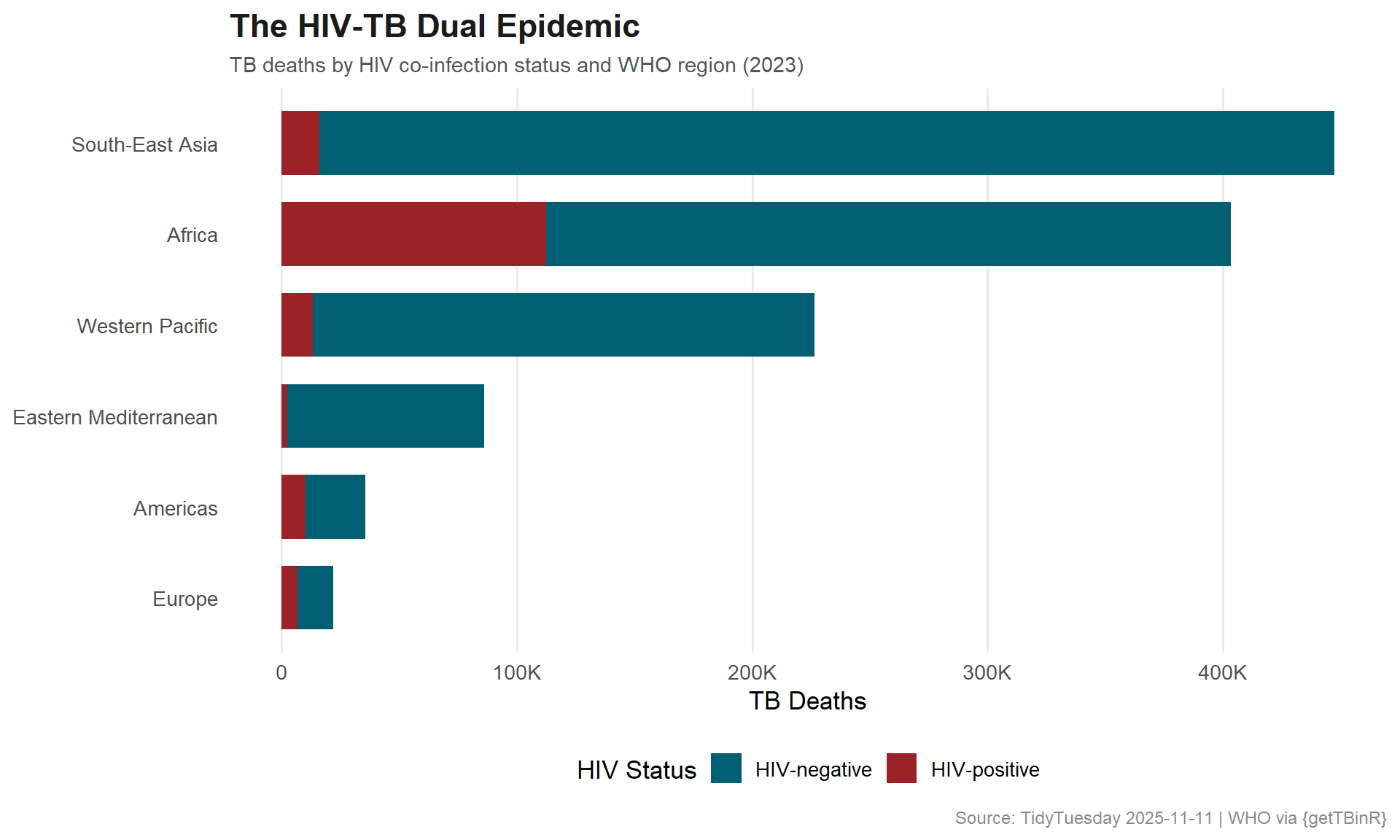
How does TB mortality differ between HIV-positive and HIV-negative populations?
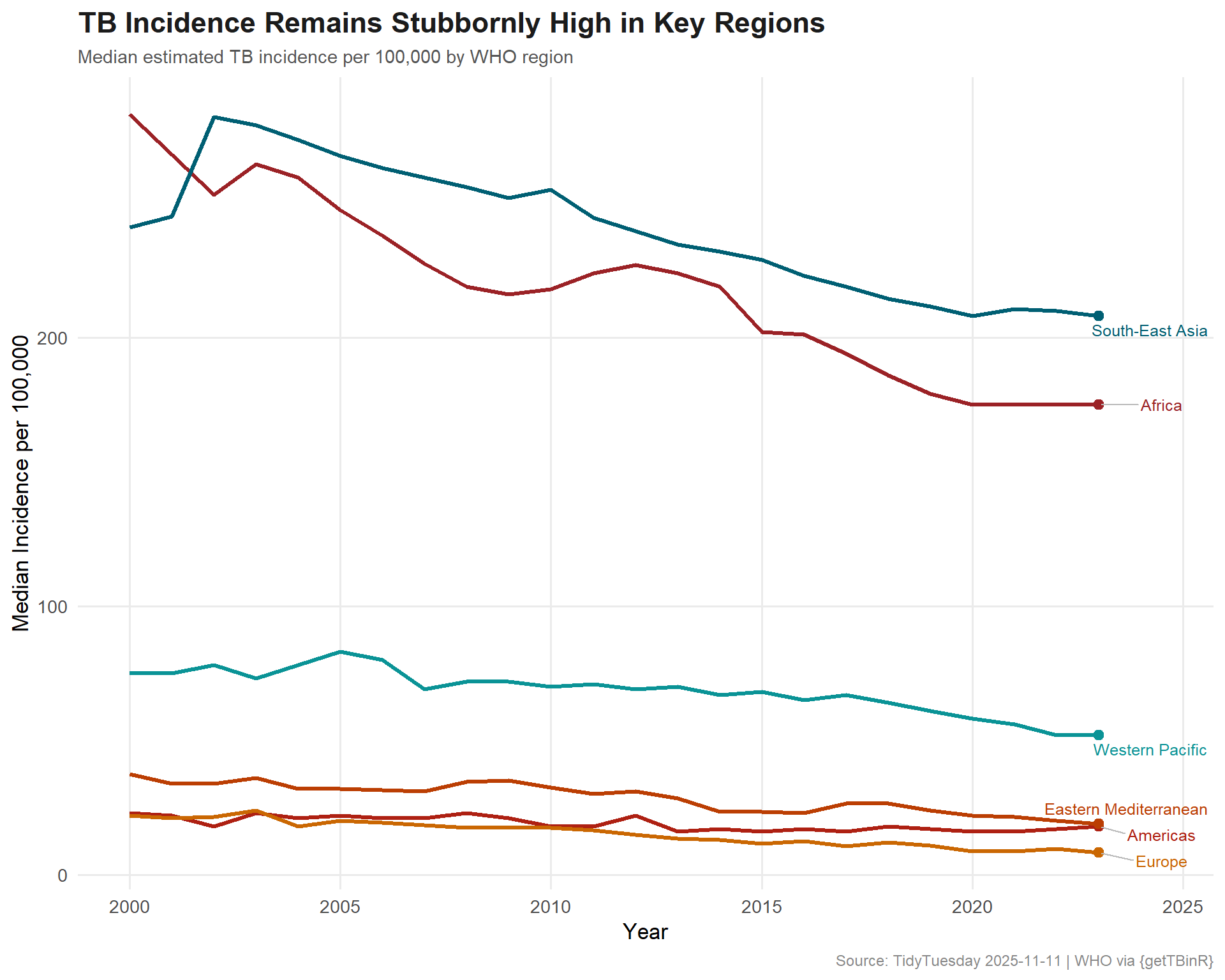
Which regions demonstrate consistently high TB burden across multiple years?
Loading necessary packages
My handy booster pack that allows me to install (if needed) and load my usual and favorite packages, as well as some helpful functions.
raw <- tidytuesdayR::tt_load('2025-11-11')tb <- raw$who_tb_data
Exploratory Data Analysis
The my_skim() function is a modified version of the skimr::skim() function that returns the number of missing data points (cells as NA) as well as the inverse (e.g.: number of rows that are notNA), the count, minimum, 25%, median, 75%, max, mean, geometric mean, and standard deviation. It also generates a little ASCII histogram. Neat!
TB Burden
tb %>%my_skim(.)
Data summary
Name
Piped data
Number of rows
5117
Number of columns
18
_______________________
Column type frequency:
character
4
numeric
14
________________________
Group variables
None
Variable type: character
skim_variable
n_missing
complete_rate
min
max
empty
n_unique
whitespace
country
0
1
4
56
0
215
0
g_whoregion
0
1
6
21
0
6
0
iso2
0
1
2
4
0
215
0
iso3
0
1
3
3
0
215
0
Variable type: numeric
skim_variable
n_missing
complete_rate
n
min
p25
med
p75
max
mean
geo_mean
sd
hist
iso_numeric
0
1.00
5117
4
212.00
430.00
646.00
894
431.79
315.72
253.11
▇▇▇▇▆
year
0
1.00
5117
2000
2006.00
2012.00
2018.00
2023
2011.56
2011.55
6.91
▇▇▆▇▇
c_cdr
293
0.94
5117
0
60.00
80.00
87.00
240
73.36
70.45
19.44
▁▇▁▁▁
c_newinc_100k
185
0.96
5117
0
10.00
36.00
95.00
947
73.33
33.09
104.03
▇▁▁▁▁
cfr
128
0.97
5117
0
0.08
0.11
0.22
1
0.16
0.12
0.13
▇▂▁▁▁
e_inc_100k
0
1.00
5117
0
12.00
46.00
160.00
1590
122.49
45.27
183.69
▇▁▁▁▁
e_inc_num
0
1.00
5117
0
210.00
2900.00
17000.00
3590000
52027.21
1973.33
250579.80
▇▁▁▁▁
e_mort_100k
24
1.00
5117
0
0.96
4.50
23.00
533
25.44
5.27
53.26
▇▁▁▁▁
e_mort_exc_tbhiv_100k
24
1.00
5117
0
0.85
3.80
19.00
188
14.44
4.14
22.34
▇▁▁▁▁
e_mort_exc_tbhiv_num
24
1.00
5117
0
15.00
210.00
1700.00
786000
6631.70
230.91
37001.66
▇▁▁▁▁
e_mort_num
24
1.00
5117
0
18.00
260.00
2800.00
979000
8975.11
294.52
45867.33
▇▁▁▁▁
e_mort_tbhiv_100k
24
1.00
5117
0
0.01
0.19
2.20
481
10.95
0.69
38.68
▇▁▁▁▁
e_mort_tbhiv_num
24
1.00
5117
0
0.00
16.00
340.00
223000
2333.54
92.96
12056.61
▇▁▁▁▁
e_pop_num
0
1.00
5117
1552
762582.00
5939341.00
21547461.00
1438069593
33406512.96
3624185.87
131759733.15
▇▁▁▁▁
tb %>% dplyr::count(g_whoregion, sort =TRUE)
# A tibble: 6 × 2
  g_whoregion               n
  <chr>                 <int>
1 Europe                 1286
2 Africa                 1117
3 Americas               1060
4 Western Pacific         888
5 Eastern Mediterranean   528
6 South-East Asia         238
In the African region, HIV-associated TB mortality accounts for a substantial share of all TB deaths — a dual epidemic that demands integrated treatment programs addressing both diseases simultaneously.
# A tibble: 10 × 6
   country                    g_whoregion e_inc_num e_inc_100k e_mort_100k c_cdr
   <chr>                      <chr>           <dbl>      <dbl>       <dbl> <dbl>
 1 India                      South-East…   2800000        195        22      85
 2 Indonesia                  Western Pa…   1090000        387        47      74
 3 China                      Western Pa…    741000         52         1.9    76
 4 Philippines                Western Pa…    739000        643        32      78
 5 Pakistan                   Eastern Me…    686000        277        20      69
 6 Nigeria                    Africa         499000        219        31      74
 7 Bangladesh                 South-East…    379000        221        26      80
 8 Democratic Republic of th… Africa         334000        316        41      77
 9 Myanmar                    South-East…    302000        558        90      43
10 South Africa               Africa         270000        427        88      79
Visualizing the Global TB Burden
# Public health palette — clinical but humanregion_cols <-c("#9B2226", # deep red"#AE2012", # rust"#BB3E03", # dark orange"#CA6702", # amber"#005F73", # deep teal"#0A9396"# teal)ggplot(regional_trend, aes(x = year, y = median_incidence, color = g_whoregion)) +geom_line(linewidth =1.1) +geom_point(data = regional_trend %>%group_by(g_whoregion) %>%slice_max(year, n =1),size =2.5 ) +geom_text_repel(data = regional_trend %>%group_by(g_whoregion) %>%slice_max(year, n =1),aes(label = g_whoregion),nudge_x =1.5,size =3.3,direction ="y",segment.color ="#BBBBBB" ) +scale_color_manual(values = region_cols) +scale_y_continuous(labels = scales::comma) +labs(title ="TB Incidence Remains Stubbornly High in Key Regions",subtitle ="Median estimated TB incidence per 100,000 by WHO region",x ="Year",y ="Median Incidence per 100,000",caption ="Source: TidyTuesday 2025-11-11 | WHO via {getTBinR}" ) +theme_minimal(base_size =13) +theme(plot.title =element_text(face ="bold", size =17, color ="#1B1B1B"),plot.subtitle =element_text(size =11, color ="#555555"),plot.caption =element_text(size =9, color ="#888888"),legend.position ="none",panel.grid.minor =element_blank() )
hiv_long <- hiv_tb %>%select(g_whoregion, year, mort_hiv_pos, mort_hiv_neg) %>%pivot_longer(cols =starts_with("mort_"),names_to ="hiv_status",values_to ="deaths" ) %>%mutate(hiv_label =ifelse(hiv_status =="mort_hiv_pos", "HIV-positive", "HIV-negative") )# Focus on latest yearhiv_latest <- hiv_long %>%filter(year ==max(year)) %>%group_by(g_whoregion) %>%mutate(total =sum(deaths), pct = deaths / total) %>%ungroup() %>%mutate(g_whoregion =fct_reorder(g_whoregion, total))hiv_cols <-c("HIV-positive"="#9B2226", "HIV-negative"="#005F73")ggplot(hiv_latest, aes(x = g_whoregion, y = deaths, fill = hiv_label)) +geom_col(width =0.7) +scale_y_continuous(labels = scales::label_number(scale_cut = scales::cut_short_scale())) +scale_fill_manual(values = hiv_cols, name ="HIV Status") +coord_flip() +labs(title ="The HIV-TB Dual Epidemic",subtitle =paste0("TB deaths by HIV co-infection status and WHO region (", max(hiv_tb$year), ")"),x =NULL,y ="TB Deaths",caption ="Source: TidyTuesday 2025-11-11 | WHO via {getTBinR}" ) +theme_minimal(base_size =13) +theme(plot.title =element_text(face ="bold", size =17, color ="#1B1B1B"),plot.subtitle =element_text(size =11, color ="#555555"),plot.caption =element_text(size =9, color ="#888888"),legend.position ="bottom",panel.grid.major.y =element_blank(),panel.grid.minor =element_blank() )
Final thoughts and takeaways
Tuberculosis is a disease of inequality. The data shows that TB burden clusters overwhelmingly in the South-East Asia and African regions, where poverty, overcrowding, and weak health systems create perfect conditions for transmission. Despite being both preventable and curable, TB kills more than 1.5 million people annually — making it the world’s deadliest infectious disease alongside COVID-19.
The HIV-TB co-infection story is particularly stark in sub-Saharan Africa, where the two epidemics feed on each other. HIV weakens the immune system, making TB infection more likely to progress to active disease. TB, in turn, accelerates HIV progression. Integrated treatment programs that address both diseases simultaneously have been a critical public health innovation.
Tip
The case detection rate (c_cdr) is a crucial indicator that often gets overlooked. A country can have high incidence but low detection — meaning people are getting sick but not being diagnosed or treated. This “missing” TB is both a humanitarian crisis and an ongoing transmission risk.