
Tidy Tuesday: Coastal Ocean Temperature by Depth
tidytuesday
R
oceanography
climate
Exploring vertical temperature profiles in Lunenburg County’s coastal waters.
Preface
From TidyTuesday repository.
This dataset explores the complex relationship between ocean depth and mean water temperature in coastal monitoring sites.
Loading necessary packages
My handy booster pack that allows me to install (if needed) and load my usual and favorite packages, as well as some helpful functions.
Code
# Packages ----------------------------------------------------------------

{
  # Install pak if it's not already installed
  if (!requireNamespace("pak", quietly = TRUE)) {
    install.packages("pak", repos = "https://cloud.r-project.org")
  }

  # CRAN Packages ----
  install_booster_pack <- function(package, load = TRUE) {
    for (pkg in package) {
      if (!requireNamespace(pkg, quietly = TRUE)) {
        pak::pkg_install(pkg)
      }
      if (load) {
        library(pkg, character.only = TRUE)
      }
    }
  }

  core_packages <- c(
    'fs',
    'here',
    'janitor',
    'rio',
    'tidyverse',
    'skimr',
    'paletteer',
    'tidytuesdayR'
  )

  optional_packages <- c('gghighlight', 'ggthemes', 'patchwork')

  install_booster_pack(package = unique(c(core_packages, optional_packages)), load = TRUE)
  rm(install_booster_pack, core_packages, optional_packages)

  # Custom Functions ----

  `%ni%` <- Negate(`%in%`)

  geometric_mean <- function(x) {
    exp(mean(log(x[x > 0]), na.rm = TRUE))
  }

  my_skim <- skim_with(
    numeric = sfl(
      n = length,
      min = ~ min(.x, na.rm = T),
      p25 = ~ stats::quantile(., probs = .25, na.rm = TRUE, names = FALSE),
      med = ~ median(.x, na.rm = T),
      p75 = ~ stats::quantile(., probs = .75, na.rm = TRUE, names = FALSE),
      max = ~ max(.x, na.rm = T),
      mean = ~ mean(.x, na.rm = T),
      geo_mean = ~ geometric_mean(.x),
      sd = ~ stats::sd(., na.rm = TRUE),
      hist = ~ inline_hist(., 5)
    ),
    append = FALSE
  )
}
Load raw data from package
raw <- tidytuesdayR::tt_load('2026-03-31')

ocean_temp <- raw$ocean_temperature
deployments <- raw$ocean_temperature_deployments
Exploratory Data Analysis
The my_skim() function is a modified version of the skimr::skim() function that returns the number of missing data points (cells as NA) as well as the inverse (e.g.: number of rows that are not NA), the count, minimum, 25%, median, 75%, max, mean, geometric mean, and standard deviation. It also generates a little ASCII histogram. Neat!
Ocean Temperature Data
my_skim(ocean_temp)| Name | ocean_temp |
| Number of rows | 19165 |
| Number of columns | 5 |
| _______________________ | |
| Column type frequency: | |
| Date | 1 |
| numeric | 4 |
| ________________________ | |
| Group variables | None |
Variable type: Date
| skim_variable | n_missing | complete_rate | min | max | median | n_unique |
|---|---|---|---|---|---|---|
| date | 0 | 1 | 2018-02-20 | 2025-12-06 | 2021-12-10 | 2847 |
Variable type: numeric
| skim_variable | n_missing | complete_rate | n | min | p25 | med | p75 | max | mean | geo_mean | sd | hist |
|---|---|---|---|---|---|---|---|---|---|---|---|---|
| sensor_depth_at_low_tide_m | 0 | 1 | 19165 | 2.00 | 5.00 | 15.00 | 30.00 | 40.00 | 17.57 | 12.34 | 12.48 | ▇▇▃▃▃ |
| mean_temperature_degree_c | 0 | 1 | 19165 | 0.31 | 3.33 | 5.65 | 9.34 | 21.32 | 6.95 | 5.51 | 4.65 | ▇▇▃▂▁ |
| sd_temperature_degree_c | 0 | 1 | 19165 | 0.00 | 0.08 | 0.16 | 0.35 | 4.71 | 0.30 | 0.17 | 0.40 | ▇▁▁▁▁ |
| n_obs | 0 | 1 | 19165 | 8.00 | 96.00 | 96.00 | 96.00 | 1440.00 | 99.42 | 89.79 | 60.17 | ▇▁▁▁▁ |
The dataset contains vertical temperature measurements across multiple depths. We see a clear depth-temperature gradient.
Seasonal Stability vs Depth
How does the variance (standard deviation) of temperature behave as we go deeper? We might expect deeper waters to be more thermally stable throughout the year.
p <- ocean_temp %>%
  mutate(month = month(date, label = TRUE)) %>%
  group_by(sensor_depth_at_low_tide_m, month) %>%
  summarize(
    mean_temp = mean(mean_temperature_degree_c, na.rm = TRUE),
    sd_temp = mean(sd_temperature_degree_c, na.rm = TRUE),
    .groups = "drop"
  ) %>%
  ggplot(aes(x = month, y = mean_temp, group = factor(sensor_depth_at_low_tide_m))) +
  geom_line(aes(color = sensor_depth_at_low_tide_m), linewidth = 1.2) +
  scale_color_paletteer_c("scico::oslo", direction = -1) +
  labs(
    title = "Mean Ocean Temperature Cycles by Sensor Depth",
    subtitle = "Deepest sensors (darker) show more stability and slightly warmer winter mins",
    x = "Month",
    y = "Mean Temperature (°C)",
    color = "Depth (m)"
  ) +
  theme_minimal() +
  theme(
    legend.position = "bottom",
    plot.title = element_text(face = "bold"),
    panel.grid.minor = element_blank()
  )

p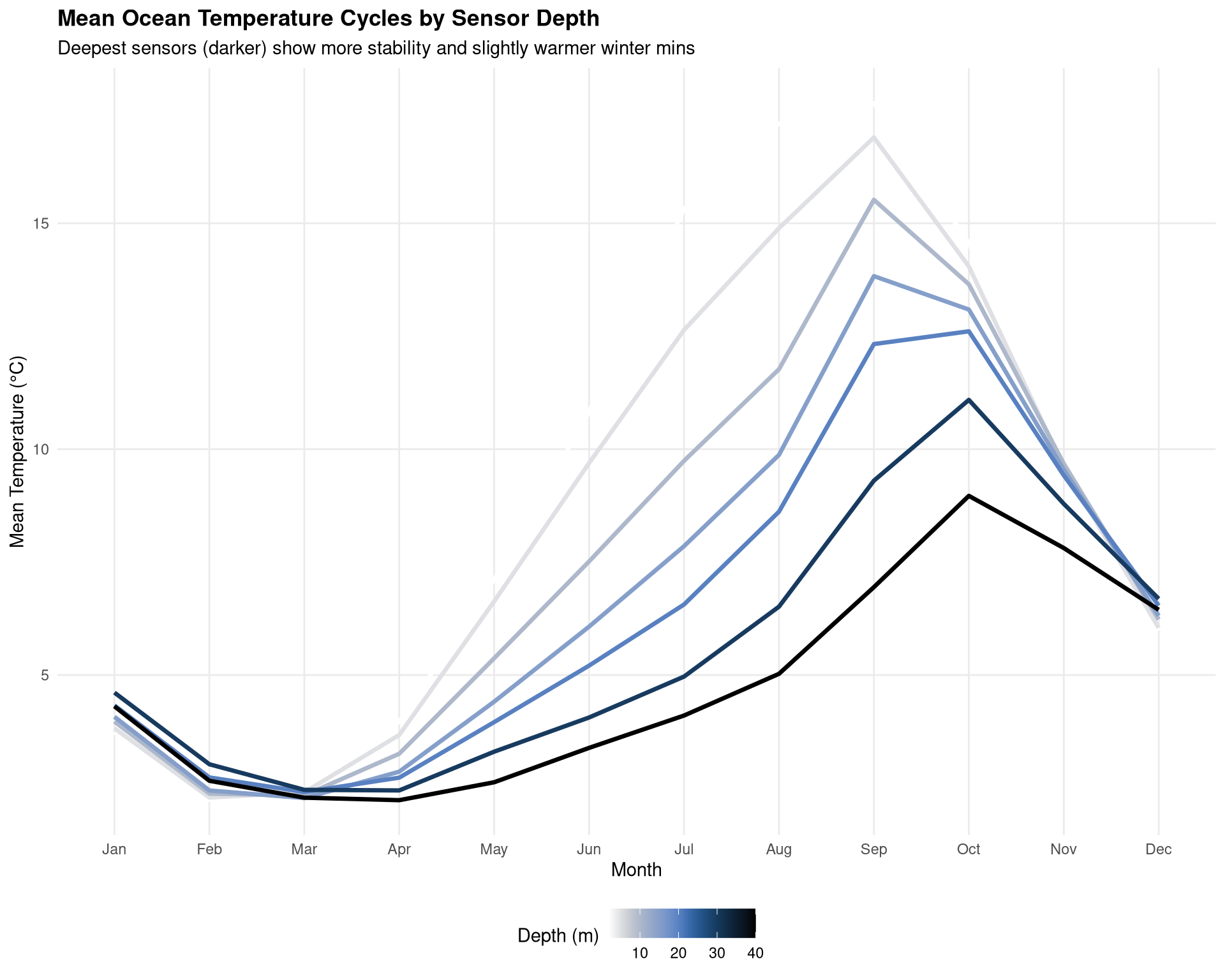
Final thoughts and takeaways
The data confirms that while the surface waters experience the most extreme swings, the deeper strata provide a more stable thermal environment, which is critical for local sea life during the transition seasons.